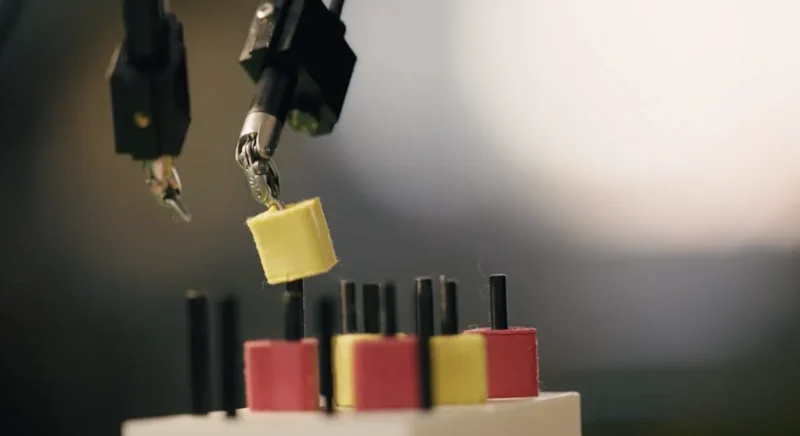
A global consortium of researchers, including a team from Hungary’s Óbuda University, is tackling one of the biggest bottlenecks in medical robotics: a lack of high-quality, large-scale data. Their solution is Open-H-Embodiment, a massive, open-source dataset designed to give surgical robots a collective memory and accelerate the development of autonomous capabilities. The project aims to be for surgical robotics what ImageNet was for computer vision—a foundational resource to fuel a new generation of AI.

The sheer scale of the project is a dramatic departure from previous efforts. While older datasets contained just a few hours of data from a single robot, Open-H-Embodiment includes approximately 780 hours of synchronized video and kinematic data. This vast collection was sourced from nearly 50 institutions worldwide and covers 20 different robotic platforms, including the widely used da Vinci Surgical System from Intuitive Surgical, Inc. Key Hungarian contributors from Óbuda University’s Antal Bejczy Center for Intelligent Robotics, such as Eszter Lukács, Tamás Haidegger, and Kristóf Takács, are listed among the authors, highlighting their role in this international effort. The entire dataset and its documentation are available on the project’s GitHub repository.
This standardized data trove is already enabling new research, as detailed in the project’s paper, “Open-H-Embodiment: A Large-Scale Dataset for Enabling Foundation Models in Medical Robotics”. The dataset is being used to train foundation models like GR00T-H, a Vision-Language-Action (VLA) model designed for surgical tasks, and Cosmos-H-Surgical-Simulator, a world model for creating realistic simulations. It’s crucial to note this is all pre-clinical work; the data captures laboratory tasks like suturing and peg transfers on phantoms and ex vivo tissue, not procedures on live patients.
Why is this important?
For years, progress in autonomous surgery has been stymied by data silos. Each research institution and robot manufacturer has its own proprietary data, making it nearly impossible to train generalist AI models that can work across different systems. Open-H-Embodiment shatters this barrier by creating a common, public foundation. This democratizes research, allowing smaller labs to compete with corporate giants and enabling the entire field to build upon a shared body of knowledge. The ultimate goal isn’t to replace surgeons, but to create hyper-competent robotic assistants that can handle tedious sub-tasks, reduce surgeon fatigue, and potentially improve precision and patient outcomes in the long run.