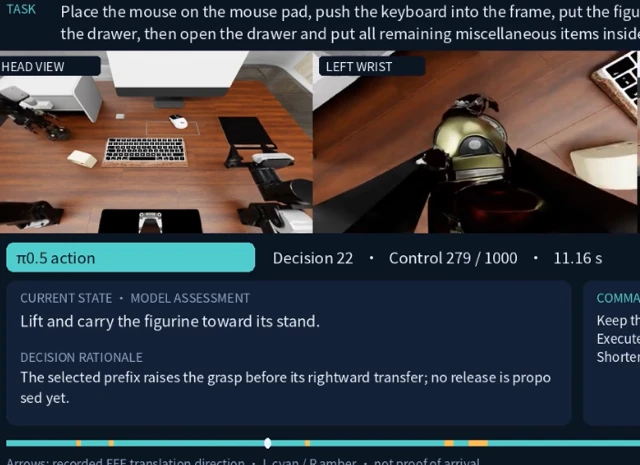
Just when you thought the robotics benchmark wars were settling down, a paper from researchers Yu-Mool Shu and Lipxin Zheng has casually dropped a new contender that doesn’t just raise the bar—it launches it into a different orbit. Titled “GPT 6 Astra as an Embodied Policy,” the research unveils a new model that obliterates the competition on the RoboDojo manipulation benchmark, a suite of dozens of simulated and real-world tasks designed to test generalist robots.
The results are, to put it mildly, lopsided. The new policy, a hybrid system combining a controller called π₀.₅ with the formidable GPT-6 Astra model, achieved a mean score of 62.6 across ten tasks. The next-closest competitor, Galaxea G0.5, lagged behind at just 38.26. That’s not an incremental improvement; it’s a 64% performance leap that makes established models from companies like Xiaomi and Meituan look like they’re running in slow motion. The work appears to build on previous research into co-training vision-language-action models on diverse data to achieve better generalization in the real world.
Interestingly, the paper also benchmarks “GPT 6 Astra Direct” control, which scores a pedestrian 37.81. This highlights the critical role of the π₀.₅ hybrid controller, which seems to translate the raw intelligence of the large model into nuanced, effective physical actions. The open-source nature of the project, indicated by a GitHub link on their site, means the rest of the industry will be scrambling to replicate and understand this new architecture. You can find the project page and data here: GPT 6 Astra as an Embodied Policy.
Why is this important?
This isn’t just about a higher score on a chart. It signals a potential shift away from monolithic, end-to-end policies toward more sophisticated hybrid systems. The massive performance gap suggests that combining a powerful, generalist “brain” like GPT-6 Astra with a specialized, fine-grained motor control policy like π₀.₅ is vastly more effective than relying on the large model to handle everything directly. For an industry that has seen even top models struggle to achieve double-digit success rates on complex real-world tasks, this could be the architectural breakthrough needed to move robots from the lab into environments that weren’t meticulously pre-arranged for them.