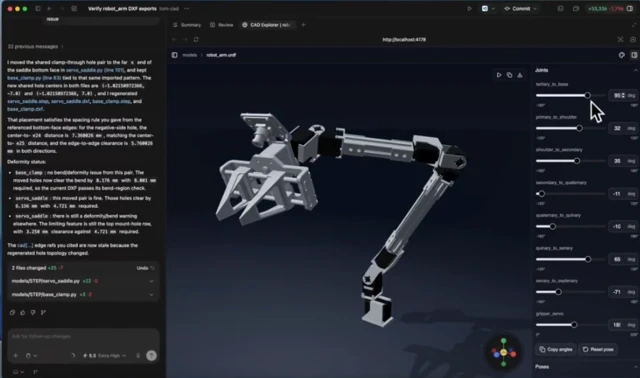
If you’ve ever wished you could just tell your computer to design a robot part instead of wrestling with complex CAD software, your oddly specific prayers have been answered. A new open-source project called text-to-cad has emerged, offering a collection of AI agent “skills” that can turn natural language prompts into a startlingly wide array of engineering files. This isn’t just about making pretty pictures; it’s about generating functional, manufacturable, and simulation-ready hardware from a conversation.
Developed by Jake Orthwein, the tool is a veritable Swiss Army knife for hardware creation. According to the project’s official announcement, it can generate everything from STEP files for traditional CAD workflows to simulation artifacts like URDF and SDF—a massive time-saver for roboticists. For the prototyping crowd, it spits out 3D mesh files such as STL, 3MF, and GLB, and can even produce gcode for direct 3D printing. The project has already garnered over 11,000 stars on GitHub, signaling a massive interest from the developer and robotics community.
Perhaps most impressively, text-to-cad incorporates practical manufacturing constraints. The AI agent can perform Design for Manufacturing (DFM) checks for popular fabrication services like SendCutSend, ensuring that your AI-generated bracket doesn’t just look good on screen but can actually be built without breaking the bank. The conversational interface allows for iterative design, where users can refine a part by simply typing follow-up commands, as if instructing a junior engineer. The entire project is free, open-source, and available on GitHub. Hyperlink: text-to-cad
Why is this important?
Tools like text-to-cad represent a fundamental shift in hardware design, lowering the barrier to entry from needing years of specialized software training to simply being able to describe what you want. By integrating simulation (URDF/SDF) and manufacturing (DFM checks, gcode) file generation into a single, text-driven workflow, it radically accelerates the entire concept-to-prototype pipeline. For an industry dominated by expensive, proprietary software from titans like Autodesk and Dassault Systèmes, a powerful, free, and open-source alternative isn’t just a novelty; it’s a direct challenge to the status quo. It democratizes design and empowers a new generation of builders to create complex hardware with unprecedented speed and ease.