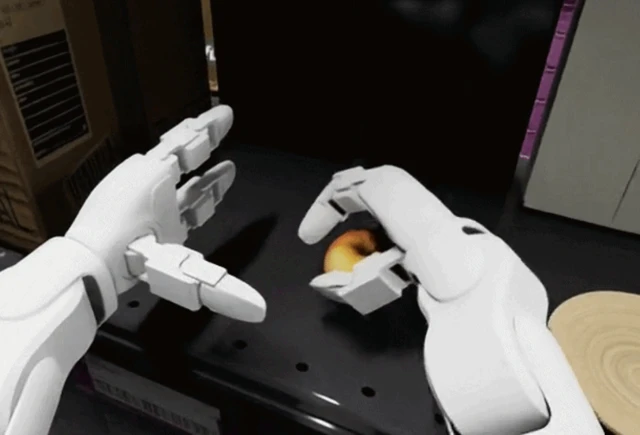
Just when you thought training a humanoid robot required a small nation’s GDP and a legion of PhDs, NVIDIA has released Project GR00T 1.7, its first open, commercially usable foundation model for humanoid robot skills. Released under a permissive Apache 2.0 license, this “Generalist Robot 00 Technology” is essentially a pre-trained brain that developers can adapt to their specific hardware. It’s less “building a mind from primordial ooze” and more “sending a gifted graduate to finishing school.”
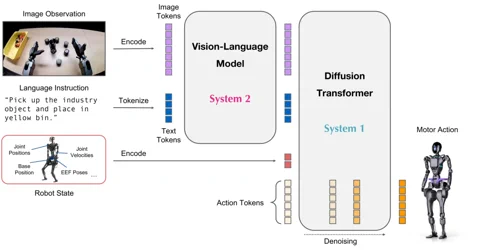
The new version is a significant step up, pretrained on a staggering ~32,000 hours of real human demonstration data and ~8,000 hours of simulated rollouts. At its core is a new Vision-Language Model (VLM) backbone, Cosmos-Reason2-2B, which replaces the previous version’s engine for better visual understanding. Crucially, this isn’t just a lab toy; NVIDIA has streamlined deployment with full pipeline export to ONNX and TensorRT, smoothing the often-treacherous path from simulation to a physical, walking robot.
The proof is in the performance benchmarks, which show consistent improvements over its predecessor. Most notably, GR00T 1.7 demonstrates a massive 61% performance jump on the DROID-F6 benchmark, indicating significantly stronger generalization capabilities. For those eager to get their hands dirty, the 3-billion-parameter base model and its code are now publicly available on Hyperlink: GitHub and Hyperlink: Hugging Face.
Why is this important?
By releasing GR00T 1.7 under a permissive Apache 2.0 license, NVIDIA isn’t just sharing a new tool; it’s making a calculated play to become the default operating system for the coming wave of humanoid robots. This move dramatically lowers the immense cost and complexity of developing capable robot intelligence, allowing startups and academic labs to stand on the shoulders of a silicon giant instead of reinventing the bipedal wheel. The message is clear: you build the body, we’ll provide the mind.