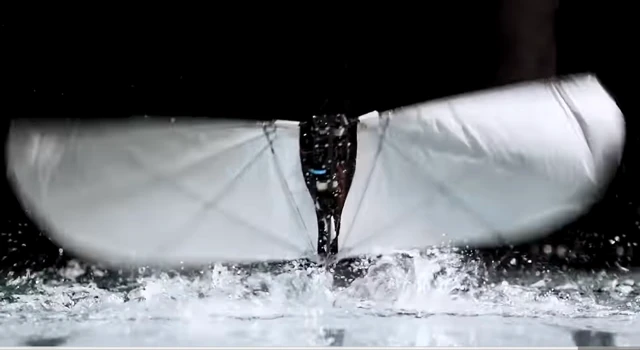
Researchers at MIT and Switzerland’s EPFL have developed a robot that flies and swims not with the brute force of propellers, but with the relative grace of flapping wings. More impressively, it can launch itself out of the water and back into the air—a feat that has stumped engineers for years. This new class of machine, dubbed a Flapping-wing Aerial Aquatic Vehicle (FAAV), takes its cues directly from diving birds like puffins.
The core challenge is the monumental difference in density between air and water. What works for flight is often hopelessly overpowered for swimming. While real birds cleverly fold their wings underwater, the researchers opted for a mechanically simpler solution: significant flexibility in the wing design. This allows the robot to flap at high frequencies (around 10 Hz) in the air and much lower frequencies (~1 Hz) in the water, all powered by the same motor system.

Getting out of the water is the hardest part, described as the most “energy-intensive intense part of the whole cycle.” The team discovered that the angle of egress is critical; the robot must breach the surface at approximately 70 degrees to successfully transition back to flight. To solve the weight problem—a traditional waterproof housing would make the robot too heavy to fly—the team individually waterproofed each electronic component. This clever move eliminates the need for an enclosure and makes the entire system neutrally buoyant by default.
Why is this important?
Propeller-driven drones are noisy, and their high-speed blades can be a hazard, especially in sensitive ecological research. A flapping-wing robot is inherently safer, quieter, and less disruptive. The creators envision a future where a scientist could carry one of these in a backpack, deploy it from shore, fly to a specific GPS coordinate, dive to take a water sample or measurement, and then fly back. This hybrid approach could unlock new, low-impact methods for environmental monitoring and ocean research, going where separate aerial and aquatic robots cannot.