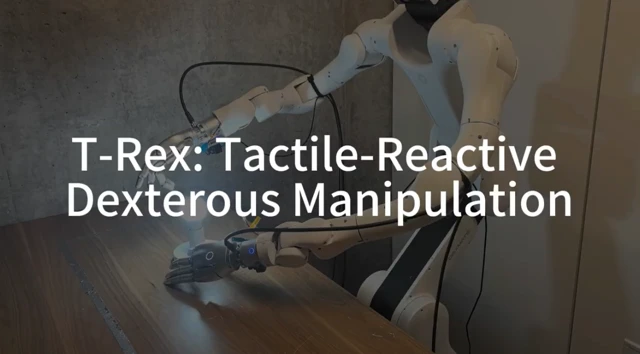
In a field where robots often have the delicate touch of a sledgehammer, a team of researchers has introduced a framework ironically named T-Rex to give machines a crucial, and largely missing, sense: reactive touch. The project, a collaboration between academic heavyweights at UC Berkeley, NVIDIA, Stanford, and other institutions, demonstrates a staggering 30% jump in success rates on complex manipulation tasks compared to the strongest vision-only models. This isn’t just an incremental improvement; it’s a fundamental shift in how robots can interact with the physical world.
Most modern robots, powered by Vision-Language-Action (VLA) models, are effectively flying blind when they make contact with an object. They see, they plan, they act—but they don’t feel an object slipping or deforming. T-Rex tackles this by integrating high-frequency tactile feedback directly into the decision-making loop. The team’s open-source release includes a massive 100-hour dataset of tactile-synchronized manipulation, featuring over 7,700 trajectories with 200+ objects, providing the critical data that has been missing in the field.
The secret sauce is a novel Mixture-of-Transformers (MoT) architecture. This design cleverly splits the robot’s “brain,” using a low-frequency expert for overall visual planning while a dedicated high-frequency expert processes the constant stream of touch data for real-time adjustments. This allows the robot to perform delicate tasks like screwing in a lightbulb, transferring an egg, or extracting a single card from a deck—actions that are trivial for humans but nightmarish for a touch-blind machine. The entire project, including the dataset, models, and training code, is being fully open-sourced, inviting the entire community to build upon this new foundation for dexterous robotics.
Why is this important?
For years, robotic manipulation has been stuck in a loop of impressive-looking but clumsy interactions. By ignoring touch, we’ve been asking robots to assemble IKEA furniture with oven mitts on. T-Rex’s success proves that tactile sensing isn’t a luxury but a necessity for achieving human-level dexterity. Making the entire stack open-source—from the 100-hour dataset to the MoT architecture—is the real game-changer. It lowers the barrier to entry for researchers worldwide, potentially triggering a Cambrian explosion of innovation in robots that can finally handle the physical world with the finesse it requires. It’s a big step toward a future where robots can do more than just pick and place; they can finally work with their hands.
You can dive into the technical details on the project website, read the full paper on arXiv, and access the code on GitHub.