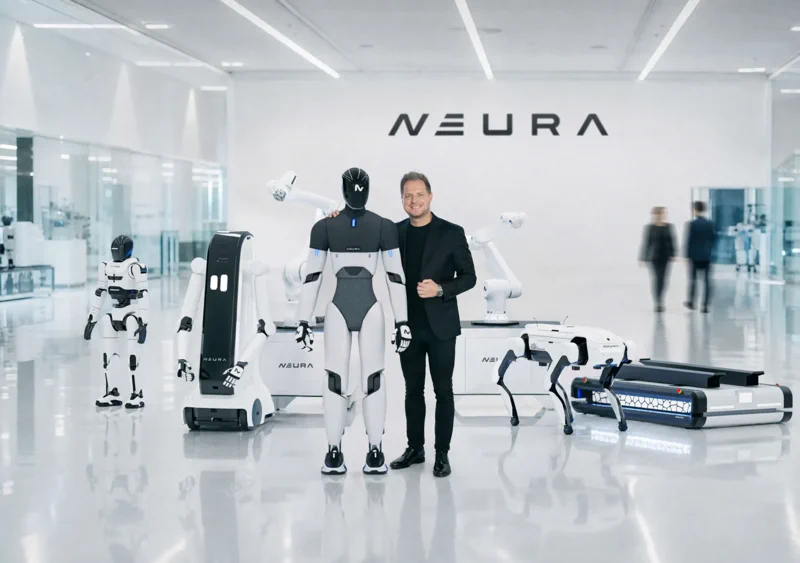
German robotics and AI firm Neura Robotics GmbH has announced a staggering Series C financing round of up to $1.4 billion, a figure the company claims is the largest ever for a full-stack robotics company. The investment, which reportedly values Neura at around $7 billion, is backed by a formidable consortium of global tech leaders, including Amazon, NVIDIA, Qualcomm Technologies, and Bosch.
The capital injection is earmarked to accelerate the global deployment of its “cognitive robots” and humanoids, expand its Neuraverse software platform, and scale manufacturing with the wildly ambitious goal of producing millions of robots by 2030. Founded in 2019 in Metzingen, Germany, Neura says it already has an existing order book exceeding $1 billion, providing a solid foundation for its aggressive expansion plans. The funding will also support the rollout of NEURA Gyms, described as large-scale, real-world training environments for its AI-powered machines.
The investor list is a veritable who’s who of the tech and industrial worlds, but one name stands out: Tether, the issuer of the world’s largest stablecoin. While the strategic interest from chipmakers like NVIDIA and industrial giants like Schaeffler is obvious, Tether’s lead role is a fascinating pivot. The crypto giant plans to integrate its wallet development kit into Neura’s platform, potentially allowing robots to autonomously transact and settle payments for completed tasks. It seems the future of work involves robots that not only do the job but also handle their own invoices.
Why is this important?
This colossal funding round is a massive vote of confidence in the “Physical AI” thesis—the idea that AI’s next frontier isn’t on screens, but in the physical world. While American and Chinese firms have often dominated the robotics conversation, this investment positions Neura as a heavily armed European contender in the race to build embodied AI.
The carefully worded “up to $1.4 billion” suggests a complex deal likely tied to milestones, not a simple blank check. Still, it provides Neura with a formidable war chest to challenge other major players in the humanoid and cognitive robotics space. The real test now is execution: turning billions in funding into millions of reliable, deployed robots that can function outside the lab. The race for the world’s robotic workforce just hit ludicrous speed.