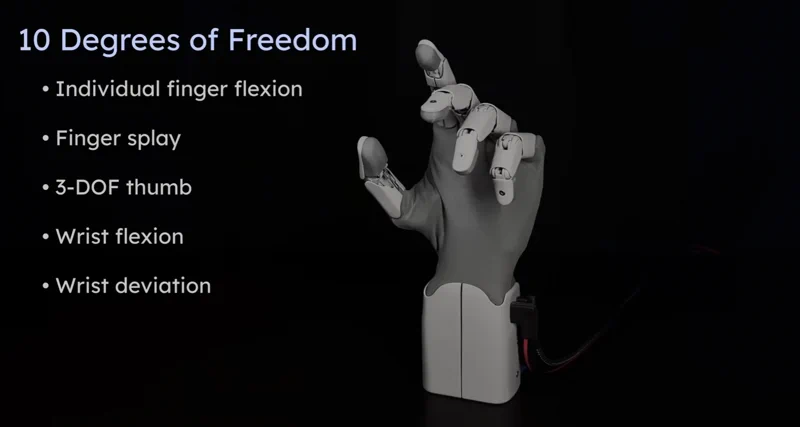
Gesture Platforms has thrown down the gauntlet—or rather, a highly dexterous robotic hand—on Kickstarter with its new Gesture HW1. The company is betting that researchers, makers, and educators are tired of their robot arms ending in what amounts to a glorified arcade claw. The HW1 is a 10-degree-of-freedom (DOF) robotic hand and wrist that promises high fidelity without the typically astronomical price tag.
The project, which blew past its modest $10,000 funding goal, offers a compelling feature set for its sub-$1000 price point. Weighing in at a nimble 480g, the HW1 boasts 10 actuated degrees of freedom, including individual finger flexion, finger splay, a 3-DOF thumb, and a 2-DOF wrist. This allows it to mimic a wide range of human grasps and poses. Gesture Platforms is also emphasizing practicality: the device is designed to be user-repairable with just a hex key and comes with a plug-and-play desktop application, eliminating a significant software hurdle for many users.
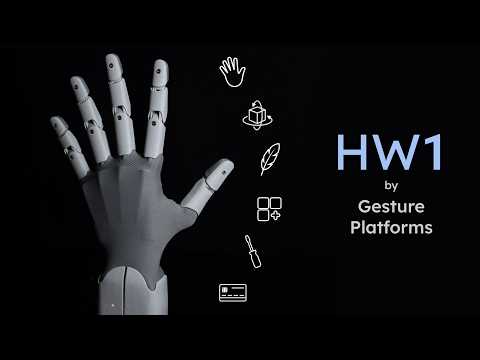
The Kickstarter campaign prices the HW1 aggressively, with early bird tiers starting at $849, a significant discount from the planned $1299 MSRP. This positions it in a largely underserved niche between simple, low-cost grippers and the five- or six-figure hands used in high-end research labs, like those from Shadow Robot Company.
Why is this important?
Dexterous manipulation has long been a major barrier in robotics, primarily due to cost. Most labs and hobbyists are priced out of hands that can perform complex, human-like tasks. Projects like Carnegie Mellon’s LEAP Hand and now the Gesture HW1 are challenging that paradigm by drastically lowering the cost of entry.
By offering a reliable, repairable, and relatively affordable platform, Gesture Platforms is democratizing access to advanced manipulation hardware. This could accelerate research in areas like reinforcement learning, human-robot interaction, and teleoperation, enabling smaller teams and even individuals to experiment with tasks that were previously the exclusive domain of deep-pocketed corporate and academic labs. If the planned Python and C++ SDKs materialize, the HW1 could become a go-to piece of kit for the next wave of robotics innovation.