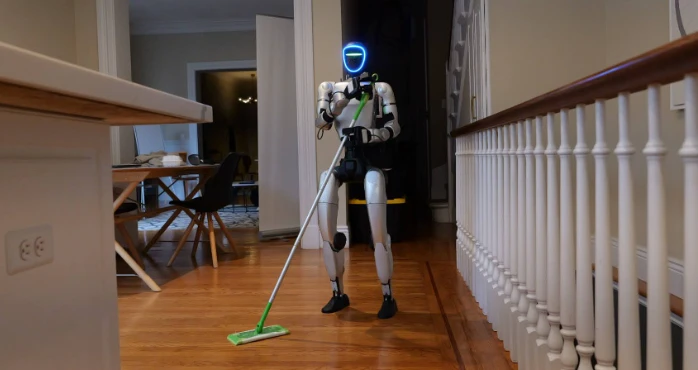
The domestic robotics market is suddenly presenting a fascinating choice: let a company clean your home for free in exchange for data to train their future robot army, or pay a premium for a humanoid to do the job with no strings attached. San Francisco-based startup Gatsby is betting you’ll choose the latter, launching an on-demand humanoid robot cleaning service for a flat fee of $150.
This move puts Gatsby, operating under its parent company West Egg Labs, in direct philosophical opposition to companies like Shift, which, as Shift Offers Free Cleaning, But Your Mess Is Training the Robot That Will Replace You , offers complimentary cleaning precisely because your mess is the perfect training ground for their AI. Gatsby, however, is selling convenience and privacy. For a price competitive with the average human cleaner in San Francisco ($150-$300), the company will dispatch a full-size humanoid robot to your apartment to handle dishes, surfaces, floors, and even fold laundry. The entire process is booked through an iOS app, with no human interaction required.
Interestingly, Gatsby isn’t building its own hardware. The company describes itself as a “robot-agnostic” consumer distribution platform, aiming to be the service layer that connects customers with the best-performing humanoids from manufacturers like 1X, Figure, or Sunday. It’s a classic Silicon Valley platform play: let others fight the brutal hardware wars while you own the customer relationship. The company claims the routine parts of the clean are fully autonomous. However, its website also states that “the harder parts are teleoperated by real humans to make sure everything’s done right,” a critical detail absent from its privacy policy. When a company’s entire value proposition is “no strangers in your home,” the presence of a remote pair of eyes is a rather significant detail. RoboHorizon has reached out to Gatsby for clarification on their teleoperation policies and data handling.
Why is this important?
Gatsby’s launch signals a schism in the emerging domestic robotics market. On one side, you have the data-for-service model, where consumers trade privacy for convenience. On the other, Gatsby is establishing a premium tier where privacy itself is the product. Their $150 price point isn’t meant to undercut the human cleaning market but to match it, offering a different kind of value: no scheduling headaches, no cancellations, and no awkward small talk.
The success of this “Uber for humanoids” model will depend on execution and transparency. While the promise of a fully autonomous clean is the ultimate goal, the quiet mention of human teleoperators is a reminder that we’re still in the early innings. How Gatsby navigates questions of privacy and the uncanny valley of remote human assistance will determine if it becomes the great new standard in home automation or just another curious experiment.