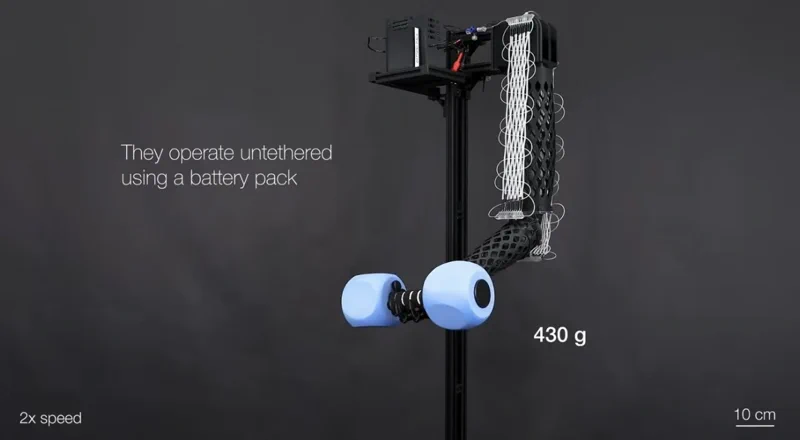
Researchers at the École polytechnique fédérale de Lausanne (EPFL) have developed a technology that sounds like it was lifted from a sci-fi novel: artificial muscle fibers that can be woven directly into clothing to create a soft, wearable exoskeleton. These Electrofluidic Fiber Muscles are not only powerful—with bundles capable of lifting 200 times their own weight—but they’re also silent, flexible, and entirely machine-washable.
The key innovation is the integration of flexible, millimeter-scale pumps directly into the fibers themselves. Instead of relying on the bulky, noisy compressors that power most contemporary soft robotics, these fibers use electric fields to move fluid via a process called charge-injection electrohydrodynamics (EHD). This self-contained system generates an impressive power density of up to 50 W/kg, a figure comparable to human skeletal muscle, all without any external hardware, noise, or vibration.
The fibers, which are about 2 millimeters thick, are essentially tiny, self-powered hydraulic systems. By bundling or weaving them into a garment, you can create textiles that actively provide muscular support, haptic feedback, or even thermoregulation. The original research paper, published in the journal Science, demonstrates the system’s potential in a variety of applications. You can read the full paper here: Electrofluidic fiber muscles for untethered and silent robotics.
Why is this important?
This technology represents a fundamental shift in how we approach wearable robotics. For years, the dream of an exoskeleton has been weighed down—literally—by the need for rigid frames and loud, power-hungry pneumatic or hydraulic systems. The EPFL fiber pumps eliminate that entire layer of complexity, embedding the actuation mechanism directly into the fabric.
The implications are vast. This could lead to lightweight, comfortable exosuits that assist patients with mobility issues during rehabilitation, or garments that reduce strain for workers in physically demanding jobs. Because the fibers are silent and discreet, the technology could easily cross over into consumer electronics, creating haptic feedback suits for virtual reality or apparel that subtly enhances the wearer’s strength. It’s the difference between strapping on a robot and simply putting on a shirt that makes you stronger.