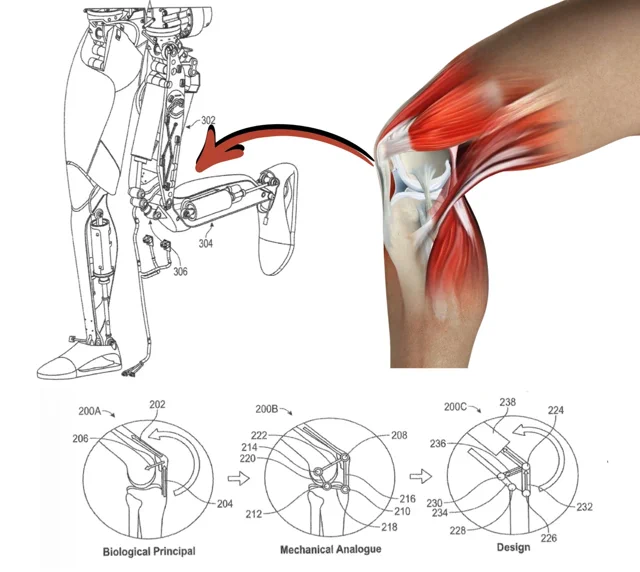
On April 9, 2026, the US Patent and Trademark Office published a Tesla, Inc. filing that contained no neural networks, no world models, and zero mention of AI. Instead, patent US20260097493A1 describes, in painstaking detail, a knee. Filed on the same day as Tesla’s 2022 AI Day, the patent reveals the bio-inspired mechanics behind the Optimus humanoid. Just days before the publication, CEO Elon Musk posted on X that “Optimus 3 is walking around, but needs some finishing touches.” This is, almost certainly, the knee it’s walking on.
The patent’s most revealing figure isn’t a complex CAD drawing but a simple, three-panel story. It starts with a diagram of a human knee labeled “Biological Principle,” moves to a stick-figure “Mechanical Analogue,” and ends with the final “Design.” The document explicitly maps the quadriceps, patella, and ligaments to a four-bar linkage. This isn’t just a robot part; it’s a direct mechanical translation of millions of years of evolution. The design provides a human-equivalent 150 degrees of rotation from a single, small linear actuator.
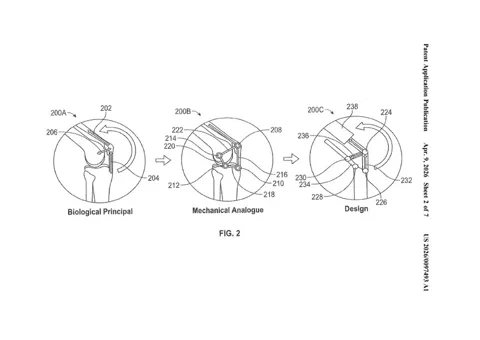
The mechanism, a modified inverse Hoecken’s linkage, is an elegant solution to a complex problem. The human knee is efficient because it doesn’t pivot on a single point; the leverage changes as it bends, maximizing torque when needed most. Tesla’s four-bar system replicates this variable mechanical advantage, allowing a small motor to produce a powerful and wide-ranging motion. The patent shows how simulations were used to find the optimal link lengths to minimize power consumption while hitting torque and speed targets.
Why is this important?
This knee is the key to making Optimus affordable. By using one small actuator instead of a more complex and power-hungry assembly, Tesla dramatically cuts the cost, weight, and complexity of each leg. This is critical for hitting Musk’s ambitious target price of $20,000–$30,000 per robot. These savings are essential for the planned production of one million units per year at the Fremont factory, which is already clearing space by ending production of the Model S and X.
While the design is clever, the underlying geometry isn’t exclusive to Tesla. Analysts have noted that the next-generation IRON humanoid from Xpeng appears to use a remarkably similar linkage. With Tesla’s design public since its 2022 AI Day, it seems the industry is converging on the most efficient designs. Evolution had millions of years to work out the geometry. Tesla has to match it on a budget.