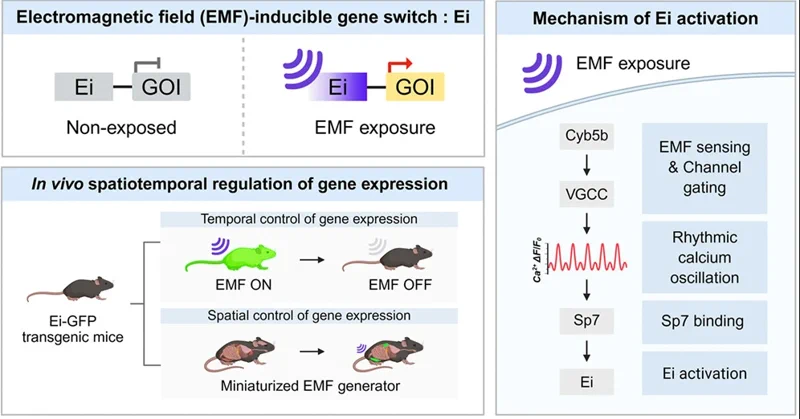
In a development that feels ripped from a science fiction manuscript, researchers in South Korea have devised a method to wirelessly activate specific genes in living mice using the same 60 Hz frequency as a standard wall outlet. The groundbreaking study, published in the journal Cell, introduces a non-invasive “magnetogenetic” switch that could revolutionize how we study and potentially treat diseases.
The team, reportedly from the Korea Advanced Institute of Science and Technology (KAIST), demonstrated the system’s power by performing some truly astonishing biological feats. They used their electromagnetic field setup to activate genes that trigger epigenetic reprogramming in aged mice, effectively extending their lifespan and reversing aging markers across multiple tissues. In another experiment, they could conditionally switch on mutant amyloid genes specifically in the brains of older mice, allowing for a cleaner model to study Alzheimer’s disease without the confounding variables of aging itself. All of this was achieved without drugs or implants, just a precisely controlled magnetic field.
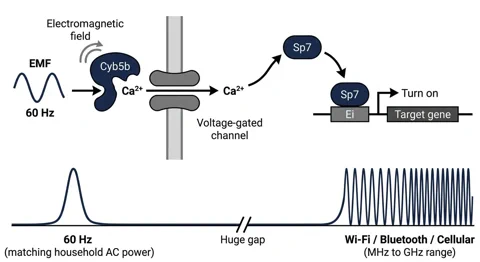
The mechanism behind this biological remote control is both elegant and specific. The low-frequency electromagnetic field is picked up by a protein called Cytochrome b5 type B (CYB5B). This interaction triggers the opening of voltage-gated calcium channels, but not in a chaotic flood. Instead, it produces rhythmic pulses of calcium ions. This specific oscillation activates a transcription factor, SP7, which then binds to a target DNA sequence and turns on the desired gene. The researchers found that simply flooding the cell with calcium using other methods had no effect; the rhythmic, patterned signal is the essential key.
Why is this important?
This research represents a significant leap for remote biological control. While techniques like optogenetics (using light to control cells) are powerful, they often require invasive fiber optic implants to deliver light deep into tissues. Magnetogenetics, by contrast, uses low-frequency fields that can penetrate the body harmlessly and non-invasively. This opens the door to therapies that could be switched on and off as needed with an external device.
The potential applications are staggering, from activating regenerative processes to targeting cancer cells with pinpoint precision. While we’re still a long way from therapeutic applications in humans, this work provides a powerful new tool for researchers and a glimpse into a future where controlling our own biology could be as simple as flipping a switch. You can read the full paper in Cell: A wirelessly controlled magnetogenetic gene switch for non-invasive programming of longevity and disease.