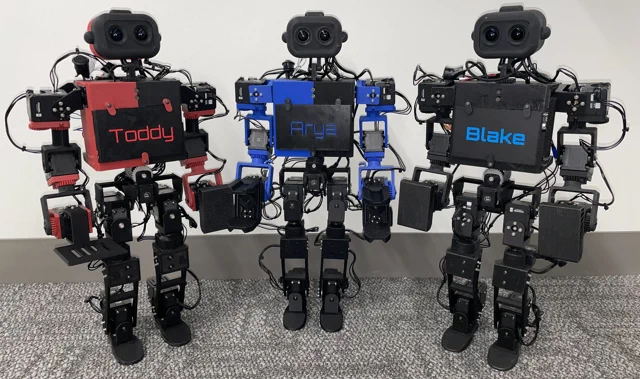
In a world where humanoid robots often carry price tags heftier than a luxury car, a new project is taking a decidedly different, and refreshingly affordable, approach. Meet ToddlerBot, a low-cost, open-source humanoid platform designed to bring advanced AI and robotics research to the masses for a bill of materials totaling under $6,000. The project, led by Stanford University Ph.D. student Haochen Shi, aims to democratize a field long dominated by well-funded corporate and academic labs.
The core idea behind ToddlerBot is to provide a scalable, reproducible platform for data-driven research, particularly in “loco-manipulation”—the complex art of moving around and handling objects simultaneously. Standing at a compact 0.56 meters and weighing 3.4 kg, the robot is designed for safe operation in real-world environments. Its 30 degrees of freedom, entirely 3D-printable body, and use of off-the-shelf components make it accessible for labs and enthusiasts with basic technical skills. The complete open-source plans, from 3D models on MakerWorld to the Python-based control code, are available on GitHub. Hyperlink: ToddlerBot on GitHub
The latest V2.0 release, available on MakerWorld, enhances the robot’s capabilities, which already include walking, crawling, and even performing push-ups. The platform is designed for machine learning compatibility from the ground up, featuring a high-fidelity digital twin for seamless sim-to-real policy transfer. This allows researchers to train AI models in simulation and deploy them on the physical robot with minimal friction.
Why is this important?
The six-figure cost of most research-grade humanoids creates a massive barrier to entry, stifling innovation. By slashing the price to around $6,000—with 90% of that cost being motors and computers—ToddlerBot opens the door for smaller universities, startups, and even ambitious hobbyists to contribute to the field. This isn’t just about making a cheaper robot; it’s about building a larger, more diverse community of researchers. An accessible platform like ToddlerBot could significantly accelerate progress in embodied AI, reinforcement learning, and physical human-robot interaction, proving that the future of robotics doesn’t have to come with a soul-crushing price tag.