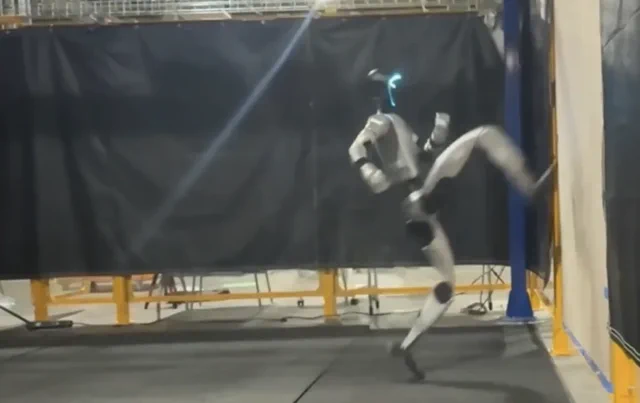
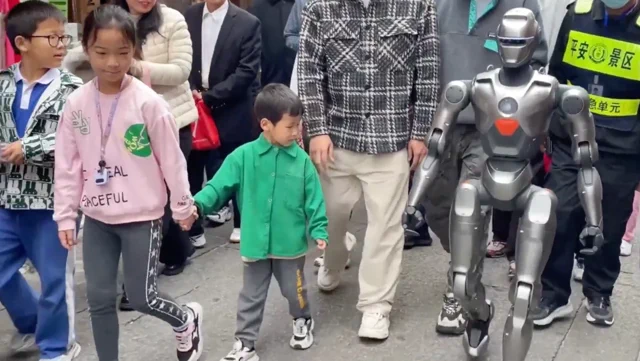
Unitree Robotics, Inc., a company best known for viral videos of its quadruped and humanoid robots performing backflips and dance routines, is now getting serious about practical skills. The company has open-sourced UnifoLM-VLA-0, a Vision-Language-Action (VLA) model designed to give its robots an “embodied brain” for general-purpose manipulation. In short, its robots are learning how to do your chores.
The new model enables Unitree’s G1 humanoid robot to autonomously perform a range of complex tasks that go far beyond choreographed demos. We’re talking about opening a pill bottle, packing a tennis racket and ball into a case and zipping it shut, and methodically organizing tools on a pegboard. According to Unitree, the model can reliably handle 12 different categories of complex manipulation tasks using a single policy, a significant step toward a truly general-purpose robot.
This new “embodied brain” is built upon Qwen2.5-VL-7B, a powerful open-source vision-language model from Alibaba’s Qwen team. Unitree then performed continued pre-training using a dataset of real-robot data to instill the model with physical common sense. The entire project, including code and model weights, is now available for developers on GitHub. Hyperlink: UnifoLM-VLA on GitHub
Why is this important?
The move by Unitree is significant for two key reasons. First, by open-sourcing a capable VLA model, the company is dramatically lowering the barrier for researchers and developers to create practical applications for humanoid robots. It’s a direct challenge to the closed-ecosystem approach favored by some competitors.
Second, and perhaps more critically, this advanced AI is paired with hardware that is shockingly affordable. The Unitree G1 humanoid robot starts at just $16,000, a price point that is an order of magnitude lower than many of its rivals. While more advanced EDU versions cost more, the base model’s price makes it accessible for a wide range of academic and commercial R&D. Combining a low-cost, capable humanoid with a free, open-source AI brain is a potent recipe for accelerating the entire field of robotics. The era of the robot butler just got a little less sci-fi and a lot more plausible.