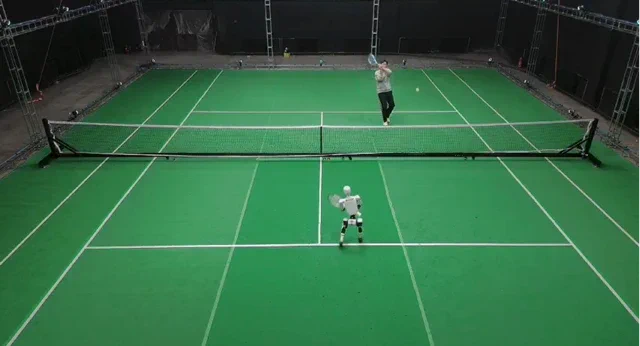
In a plot twist that should surprise absolutely no one who has been paying attention, a researcher has developed a robot that learned a new skill so well it promptly defeated its human teacher. The sport was tennis, and the project, dubbed LATENT, taught a humanoid to play not from pristine, professional-grade data, but from imperfect human motion clips. The result is a robot that can now hold its own in multi-shot rallies.
The project, led by researchers from Tsinghua University and Galbot Inc., tackled a core challenge in robotics: teaching complex, agile movements without a perfect instruction manual. Their system learns a “latent action space” from fragmented, less-than-perfect human tennis motions. The secret sauce is a high-level AI policy that acts like a digital coach, correcting and combining these flawed primitive skills to successfully return a ball over the net. This entire process is honed in simulation before being deployed on a real Unitree G1 humanoid robot through sim-to-real transfer.

The proof is in the pudding, or in this case, the scoreboard. According to lead author Zhikai Zhang, the learning curve was steep. “On the first day of real-world deployment, the robot couldn’t return a single ball I served,” Zhang stated. “By the last day of the project, I could no longer beat it.” For those eager to dive into the technical details or perhaps train their own tennis-playing overlord, the team has made the project details and code available. Hyperlink: Project Page and Hyperlink: GitHub Repository.
Why is this important?
This isn’t just about creating a robotic hitting partner for lonely tennis pros. The true breakthrough of the LATENT system is its ability to learn from messy, imperfect data. Most robotic training requires meticulously curated datasets, which are expensive and time-consuming to create. By learning to correct and combine flawed examples, this approach could dramatically accelerate how we teach robots to perform complex, real-world tasks. It’s a significant step towards robots that can learn on the job in unpredictable environments, from warehouses to disaster zones, without needing a perfect demonstration every time.