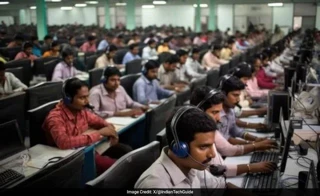
In a revelation that adds a new wrinkle to the definition of “autonomous,” Waymo’s Chief Safety Officer, Dr. Mauricio Peña, confirmed during a U.S. Senate hearing that the company uses remote human operators located in the Philippines to assist its vehicles on American roads. When a Waymo robotaxi gets flummoxed by a “difficult driving situation,” it can phone a human friend thousands of miles away for help.
Peña clarified that these operators, which Waymo calls “fleet response agents,” do not remotely drive the vehicles but rather “provide guidance” as an additional input. However, the admission drew immediate fire from lawmakers like Senator Ed Markey, who raised concerns about cybersecurity vulnerabilities, latency issues, and the safety implications of having “transatlantic backseat drivers” influencing vehicles in real-time. Peña could not provide a breakdown of how many operators were based overseas versus in the U.S.
Testifying at the same hearing, Tesla, Inc. presented a radically different security philosophy. Lars Moravy, Tesla’s VP of Vehicle Engineering, stated unequivocally that the company’s core driving controls are on a physically and digitally separate layer that “cannot be accessed from outside the vehicle.” He asserted that firmware updates require a two-person cryptographic sign-off and that no one has ever successfully taken remote control of a Tesla’s driving systems.
Why is this important?
This hearing starkly contrasted two divergent paths in the race to full autonomy. Waymo’s “human-in-the-loop” approach, reliant on a global remote workforce, offers a way to handle edge cases and scale its service. However, it also opens a Pandora’s box of potential security risks and questions the very nature of its autonomy. A system that needs a lifeline to a human operator 8,000 miles away feels less like a self-driving car and more like the world’s most sophisticated remote-control toy.
Tesla, on the other hand, is betting on a hardened, self-contained system. This architecture prioritizes security by creating an air gap around critical driving functions, but it also means the AI must solve virtually all problems on its own. While Tesla claims this makes its vehicles unhackable from the outside, it places immense pressure on the capabilities of its onboard AI. The industry is now watching to see which philosophy will prevail: the globally-networked assistant or the isolated, self-reliant machine.