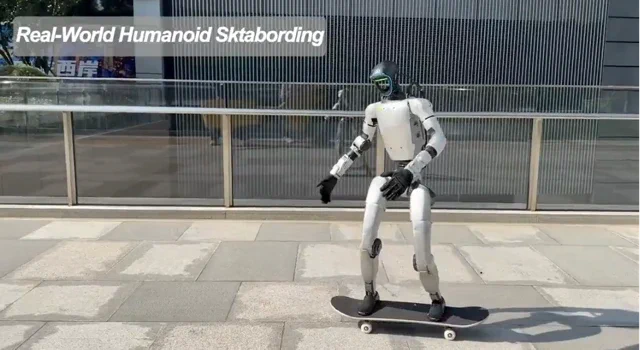
In a development that should make every teen who ever face-planted on asphalt feel slightly inadequate, researchers have taught a humanoid robot to skateboard. A new paper published on arXiv on February 3, 2026, details a system called HUSKY (Humanoid Skateboarding System), a physics-aware AI framework that allows a bipedal robot to master the dynamically unstable and mechanically coupled nightmare that is riding a plank of wood on wheels.
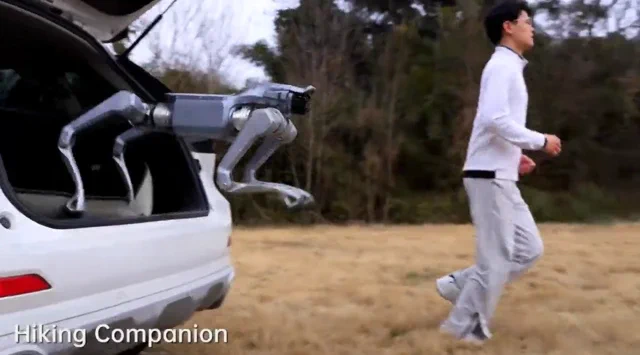
The unfortunate subject of these experiments is the Unitree G1, a humanoid robot standing about 1.3 meters tall and weighing around 35 kg. While already capable of dancing and basic manipulation, the G1, which has a starting price of around $16,000, can now add “aspiring skate park loiterer” to its resume. The HUSKY system integrates whole-body control with a deep understanding of skateboard dynamics—modeling the complex relationship between board tilt and truck steering—to enable stable transitions between pushing off the ground and steering by leaning. To achieve a more natural, human-like motion, the system leverages Adversarial Motion Priors (AMP), a technique that encourages the robot to learn from a style of movement rather than being explicitly programmed for every twitch.
Why is this important?
Teaching a robot to skateboard isn’t just about preparing for the eventual robot Olympics. This research pushes the boundaries of whole-body control for humanoids in unpredictable, real-world scenarios. Mastering an underactuated platform like a skateboard demonstrates a sophisticated ability to manage balance, momentum, and human-object interaction simultaneously. The principles behind HUSKY could be applied to robots using other wheeled tools or navigating cluttered, dynamic human environments without constantly tripping over their own feet. It’s a crucial step toward creating robots that can move with the agility and adaptability of humans, not just the rigid precision of a factory arm.