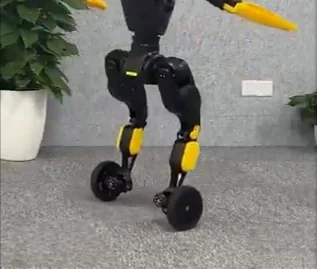
The line between a helpful AI assistant and a digital poltergeist with manipulator arms just got a little thinner. A new open-source project, ROSClaw, has emerged victorious from the SF OpenClaw Hackathon with a deceptively simple premise: to give screen-bound AI agents a body. The project provides a direct bridge between ROS 2 (Robot Operating System) and OpenClaw, one of the most viral self-hosted AI agent platforms available today.
Developed by a team led by GitHub user PlaiPin, ROSClaw allows an OpenClaw agent to discover and connect to any ROS 2 robot from a Linux or Mac machine. Using WebRTC for a secure, low-latency connection, the agent can then access the robot’s topics—effectively seeing through its cameras and reading its sensors—and issue commands to grasp and move objects in the real world. The project’s creators put it best: “Agents escaped the screen!” Now, instead of just managing your calendar, an AI can theoretically tidy your desk. Or, more likely, rearrange it according to its own inscrutable logic.
Why is this important?
This isn’t just about connecting two pieces of software; it’s about providing a physical embodiment for a new class of powerful AI. OpenClaw is not a simple chatbot; it’s a wildly popular open-source framework that allows AI to execute tasks, access local files, and control applications on a user’s machine. Until now, its domain was purely digital.
ROSClaw provides the missing piece: a standardized way for this potent digital brain to operate a physical body. By bridging the gap to the vast ecosystem of ROS-compatible robots, it dramatically lowers the barrier for thousands of AI developers to experiment with embodied AI. Giving an AI that can already write its own code the keys to a robot with a gripper arm is a bold move, and we’re here for it. The entire project is available on GitHub under an Apache-2.0 license.