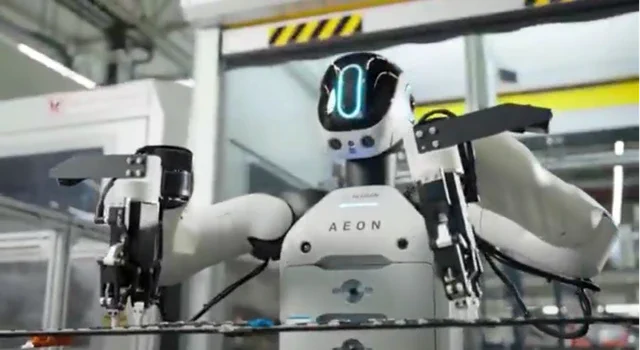
In a move that caught many industry watchers by surprise, Bayerische Motoren Werke AG (BMW) announced it is deploying humanoid robots in its European production for the first time, but it’s not the bipedal bot you’re thinking of. The German automaker is launching a pilot program at its Leipzig plant with Hexagon’s AEON robot, targeting tasks in high-voltage battery and component assembly. This decision comes just over a year after BMW’s highly publicized partnership with Figure AI, Inc. to bring humanoids to its US factory.
This development adds a fascinating wrinkle to BMW’s automation strategy. The initial agreement with Figure AI, announced in January 2024, was slated for BMW’s massive manufacturing facility in Spartanburg, South Carolina. That deal was widely seen as a landmark moment for general-purpose humanoids in automotive manufacturing. The Leipzig pilot, however, demonstrates that BMW is not putting all its robotic eggs in one basket. The German plant is a key facility, producing the BMW 1 and 2 Series, the MINI Countryman, and up to 300,000 high-voltage batteries annually.
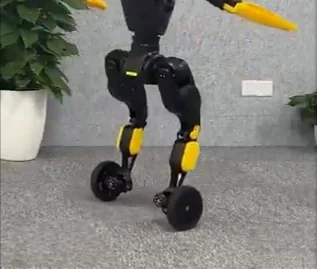
So, what is the AEON robot? While dubbed a “humanoid,” it’s more of a pragmatic cousin to the walking robots from Figure or Tesla. Developed by Swedish tech firm Hexagon AB, AEON stands 165 cm tall, weighs 60 kg, and moves on wheels, not legs. It’s a mobile manipulator designed for industrial environments, capable of carrying a 15 kg payload and even swapping its own batteries for near-continuous operation. Think less “sci-fi butler” and more “extremely capable factory assistant on a self-balancing scooter.”
Why is this important?
BMW’s two-pronged approach reveals a shrewd, if slightly convoluted, strategy for robotic integration. Rather than committing to a single humanoid platform, the automaker is testing different solutions for different continents and, crucially, different types of tasks. The Figure pilot in the US is aimed at exploring general-purpose applications, while the AEON pilot in Germany is focused on specific, structured logistics and assembly roles.
This signals that the invasion of the humanoid factory worker won’t be a monolithic takeover. Instead, we’re likely to see a fragmented landscape where specialized, wheeled “humanoids” like AEON tackle logistics while more advanced bipedal robots are slowly phased into more complex, human-centric tasks. For now, BMW is wisely playing the field, proving that in the race to automate, sometimes the tortoise on wheels has a place right alongside the sprinting hare.