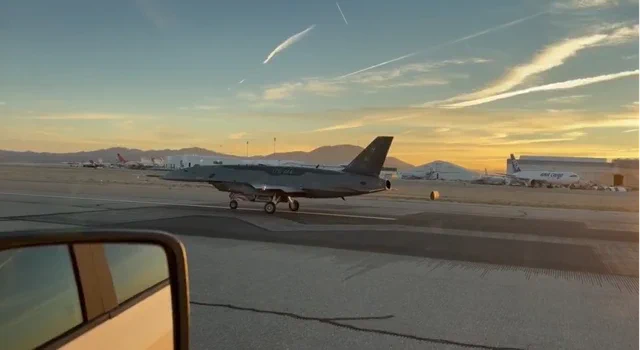
The U.S. Air Force has officially given a drone a fighter jet designation for the first time, and the honor goes to Anduril Industries, Inc.’s YFQ-44A Fury. The jet-powered, AI-piloted aircraft received its “F” for Fighter after successfully demonstrating fully autonomous flight, from high-speed taxi and takeoff to complex flight maneuvers that match the performance of a manned F-16. No pilot, no remote control stick—just an AI brain in the driver’s seat.
This milestone, revealed at the Air and Space Forces Association Warfare Symposium, marks a tectonic shift in aerial combat. The Fury, developed from a clean sheet to first flight in a blistering 556 days, recently began captive-carry flight tests with an inert AIM-120 AMRAAM missile strapped to its airframe. This is a stark contrast to legacy programs like the F-35, which has been in development since the mid-90s and has a projected lifecycle cost soaring past $2 trillion.
While Anduril’s achievement is significant, it’s worth noting they weren’t the first to get a Collaborative Combat Aircraft (CCA) prototype airborne. Rival General Atomics flew its YFQ-42A “Dark Merlin” on August 27, 2025, more than two months before the Fury’s first flight on October 31, 2025. Both companies are now in a fly-off for a production contract expected in fiscal year 2026.
Why is this important?
The “F” designation isn’t just symbolic; it’s a declaration that the era of autonomous air combat has arrived. These CCAs are designed to act as loyal wingmen, flying into contested airspace ahead of manned fighters to scout, engage threats, and provide an “affordable mass” that legacy aircraft fleets can’t match. For Anduril, a venture-backed startup now valued at over $30 billion, this is more than a successful test flight; it’s a direct challenge to the entire defense industrial base. The company is already building a 5-million-square-foot factory to mass-produce these systems, signaling its intent to make every manned fighter program on Earth a potential relic.