Boston Dynamics has apparently had a major change of heart, or at least a change of hand. Just three months after releasing a detailed video praising its minimalist, non-anthropomorphic gripper design, the company unveiled its production-ready Atlas humanoid at CES 2026 sporting a completely different, more conventional three-fingered hand. The whiplash is palpable.
Back on October 8, 2025, Boston Dynamics engineers waxed poetic about their clever gripper. It was a masterclass in pragmatic simplicity, designed to be robust and “good enough” without getting bogged down by the complexity of mimicking a human hand. Its fingers could bend backward, and a unique thumb could swing across the entire palm, enabling novel grasping strategies. It was weird, capable, and backed by a solid engineering philosophy.
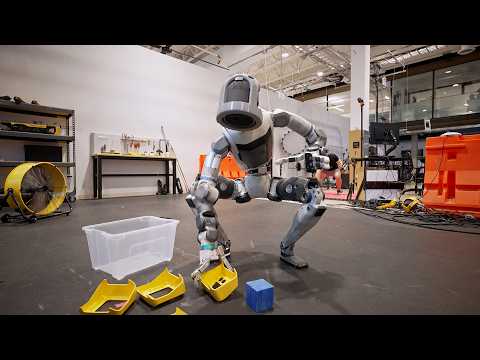
Then came CES 2026. As we covered in our initial report on the Boston Dynamics' Electric Atlas Is Here to Do Your Job, Not Steal Your Moves , the new Atlas is built for work. And apparently, work requires a different set of tools. The production model shown off in Las Vegas features a significantly more traditional three-fingered hand with an opposable thumb. While still not a five-fingered human replica, it’s a world away from the design championed just a quarter ago.
Why is this important?
This isn’t just a component swap; it’s a pivot in philosophy that speaks volumes about the commercial realities of humanoid robotics. The most likely culprit for the sudden redesign is tool use. While the previous gripper was flexible, its alien geometry may have struggled to effectively hold and manipulate the vast ecosystem of tools—drills, wrenches, screwdrivers—all designed around the five-fingered human hand. For a robot intended to integrate into human workspaces, being unable to use human tools is a non-starter.
Boston Dynamics’ rapid course correction suggests that for all the talk of superhuman capabilities, the immediate future of commercial humanoids lies in their ability to seamlessly fit into our world, not reinvent it. The company known for pushing the boundaries of what’s possible just gave us a very public lesson in pragmatism: sometimes the best design isn’t the most innovative, but the one that can actually hold the screwdriver.