For years, the grand vision of AI that improves itself has been mostly confined to the digital playgrounds of simulation. It’s one thing for an AI to master a video game; it’s another thing entirely to let it mess with expensive hardware in the unforgivingly messy real world. Now, researchers at NVIDIA, in collaboration with Carnegie Mellon University and UC Berkeley, have decided to hand over the keys to the lab. Their new framework, ENPIRE, essentially creates a self-running robot research program, and the initial results are as impressive as they are unsettling for human robotics engineers.
ENPIRE lets “agentic” AI—coding agents that can reason and act autonomously—take full control of the physically embodied learning process. The system achieved a staggering 99% success rate on dexterous manipulation tasks that would normally involve weeks of human-led trial and error, like inserting pins into a box, seating a GPU, and even cutting a zip tie with a tool. This isn’t just about tweaking a few hyperparameters; the AI agents are rewriting their own algorithms based on real-world results, effectively outsourcing the entire research and development cycle to themselves.
The Automated Feedback Loop
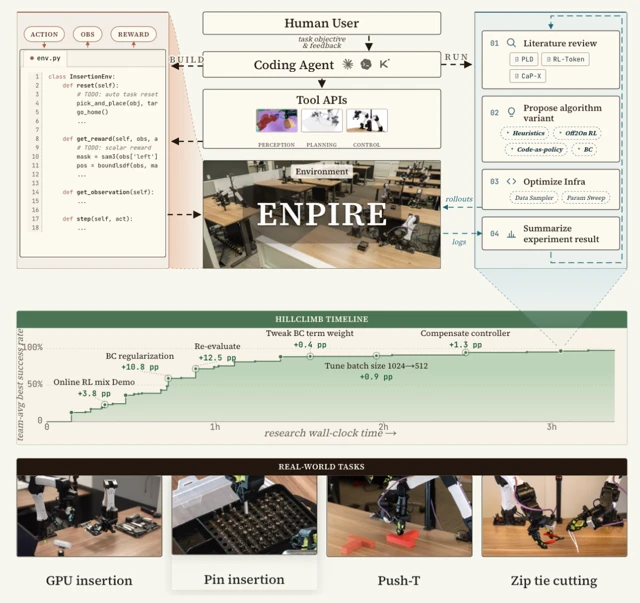
The central bottleneck in robotics has always been the laborious process of human supervision and algorithmic engineering. ENPIRE tackles this head-on by creating a closed, repeatable feedback loop that an AI can manage entirely on its own. The framework is broken down into four clever modules that give it its name:
- Environment (EN): This module automates the two most tedious parts of real-world testing: resetting the scene for the next trial and verifying the outcome. Before the AI can even start learning the main task, another agent first figures out how to automatically reset the workspace—a key insight being that resetting is often a simpler robotics problem than the task itself.
- Policy Improvement (PI): Here, the AI agents get to work. They can propose and implement a wide range of strategies to get better, from writing simple heuristics to employing complex methods like behavior cloning or reinforcement learning (RL).
- Rollout (R): This is where the metal meets the world. The module executes the agent’s proposed policy on one or more physical robots, collecting precious real-world data.
- Evolution (E): The AI agents analyze the logs from the rollouts, consult scientific literature for new ideas, and then refine the code for the next iteration. It’s a relentless, automated version of the scientific method, running 24/7.
This structure transforms the chaotic process of real-world robot learning into a clean, controllable optimization problem that requires minimal human input after the initial setup.
From Intern to Principal Investigator
What makes ENPIRE a significant leap is the level of autonomy granted to the AI. This is what NVIDIA researcher Jim Fan calls “real autoresearch.” The agents aren’t just adjusting knobs on a pre-written algorithm. They are actively exploring different programming paradigms, rewriting their own training objectives, and even modifying the data loaders.
In one instance, while learning a pin insertion task, an agent independently decided that tuning RL parameters wasn’t the best path forward. Instead, it wrote its own contact-force safety controller from scratch, which proved to be a more effective solution. This is the AI equivalent of a research intern promoting itself to lead scientist and then solving a problem the senior staff was stuck on.
The project’s “hillclimb timeline” visualizes this process beautifully, showing how different agent-proposed ideas—like adding regularization or compensating the controller—incrementally push the success rate toward that near-perfect 99% mark in just a few hours.
Scaling Up the Robotic Workforce
ENPIRE is designed to scale. The framework can manage a whole fleet of robots operating in parallel, dramatically accelerating the learning process. To quantify the efficiency of this multi-robot, multi-agent system, the researchers proposed two new metrics: Mean Robot Utilization (MRU) and Mean Token Utilization (MTU). These measure how effectively the system keeps the robots busy and how efficiently it uses its AI model’s computational budget.
The promise of this research is profound. By automating the physical feedback loop, the bottleneck in robotics could shift from painstakingly designing algorithms to designing self-contained, auto-resetting environments that AI agents can then conquer on their own.
NVIDIA has announced plans to open-source the entire ENPIRE framework, which could democratize access to advanced robotics research. Soon, anyone with a robot arm and a decent GPU might be able to set up their own self-improving robot lab at home. The era of AI teaching itself in the real world is no longer a simulation—it’s running live, cutting zip ties, and rewriting its own code for the job.
You can dive deeper into the technical details by reading the full paper. Hyperlink: Read the paper on the NVIDIA Research page.