Let’s get this out of the way immediately: a humanoid robot just ran a half-marathon faster than any human being in history. At the 2026 Beijing Humanoid Robot Half-Marathon on April 19th, a robot named “Lightning” (or “Flash”) from smartphone maker Honor autonomously navigated the 21.0975-kilometer course in a staggering 50 minutes and 26 seconds. That time obliterates the official men’s world record of 57 minutes and 20 seconds.
This isn’t just an incremental improvement. It’s a jaw-dropping leap that makes a mockery of last year’s results. The 2025 inaugural race was, to put it mildly, beautiful chaos. One robot face-planted seconds after the starting gun. Another slammed into a fence and shattered. The crowd favorite, a tiny bot named “Little Giant,” started smoking. The winner of that comedy of errors, Tiangong Ultra, finished in 2 hours, 40 minutes, and 42 seconds—a respectable achievement for the time, but still worlds away from elite human performance. In just twelve months, we’ve gone from slapstick to superhuman.
A Year of Frightening Progress
So, what happened in a year? A brute-force acceleration of both hardware and ambition, fueled by China’s aggressive industrial strategy. While Honor’s “Lightning” took the endurance crown, the entire field demonstrated terrifying gains in raw speed. Just days before the race, Unitree Robotics showed its H1 humanoid sprinting at 10.1 meters per second on a real track, putting it within spitting distance of Usain Bolt’s peak speed. This blistering pace, a threefold increase in just two years, signaled that the physical hardware was rapidly overcoming previous limitations.
The race organizers fundamentally changed the nature of the challenge for 2026. The number of participants exploded from around 20 to over 300 robots from more than 100 teams. Crucially, they introduced a major focus on autonomy. Nearly 40% of the teams competed in the fully autonomous category, where the robot handles all navigation and decision-making. To hammer the point home, remote-controlled finishers had their times multiplied by a 1.2x coefficient, effectively a penalty for needing a human in the loop. That an autonomous robot won under these conditions is the real story; it wasn’t just a faster machine, but a smarter one.
More Than a Race, It’s an Audition
This event is far more than a sporting spectacle; it’s a high-stakes commercial audition. The grand prize isn’t a trophy but over 1 million yuan (about $140,000) in industrial orders. Beijing’s E-Town, the technology hub hosting the race, has explicitly designed the marathon as a pipeline to turn research projects into commercial products. With over 100 robotics firms and a 10 billion yuan government fund, the message is clear: prove your robot works on the track, and you’ll get a purchase order to deploy it in a factory.
To that end, the organizers added a new event this year: the “Robot Baturu Challenge.” Held the day before the marathon, this challenge forced robots through 17 different obstacle courses simulating disaster rescue scenarios—testing their ability to navigate rubble, climb stairs, and handle real-world complexity. It’s a clear signal that the end goal isn’t just running, but creating machines capable of performing useful, difficult tasks in unstructured human environments. You can see how far these humanoids have come in their development in this Humanoid Robots to Run Half-Marathon in Ultimate Endurance Test .
The Technical Leap
The performance leap was enabled by across-the-board upgrades:
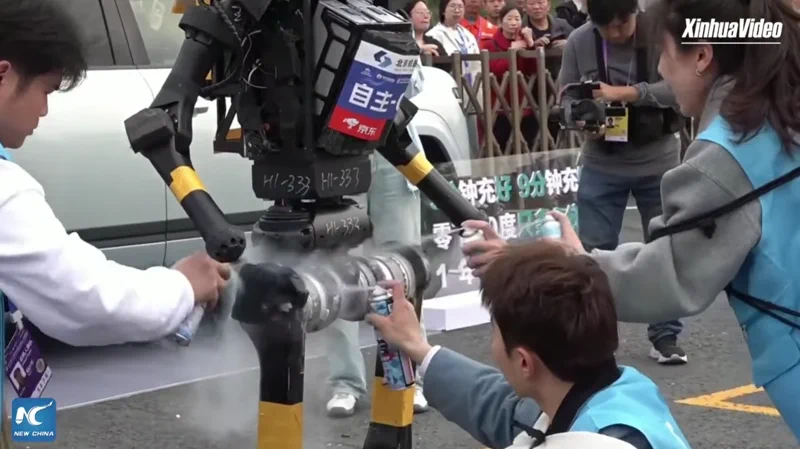
- Hardware: Improved joint torque, better power efficiency, and advanced heat management—Honor’s winning bot reportedly uses a powerful liquid-cooling system—were essential for maintaining high speeds over 21 kilometers.
- Software: More robust motion control algorithms allowed for stability on varied terrain, from city streets to park paths.
- Navigation: Every robot was equipped with a BeiDou satellite navigation badge, providing centimeter-level precision for location tracking, a must-have for autonomous operation.
The Starting Gun on a New Era
It’s tempting to get lost in the astounding 50-minute finishing time. But the true headline is the rate of progress. In a single year, the winning time improved by nearly two hours. The competition went from a novelty act where simply finishing was a victory to a legitimate athletic contest where the winning machine surpassed the pinnacle of human achievement.
While there were still stumbles—reports noted one robot falling at the start and another hitting a barrier—the overall capability of the field was night and day compared to 2025. The question is no longer if humanoids can perform complex dynamic tasks, but how quickly they will master them. The 2026 Beijing Half-Marathon wasn’t just a race; it was the starting gun for an era where the physical capabilities of robots are no longer a novelty, but a serious, world-beating reality. The rest of the world has been put on notice.