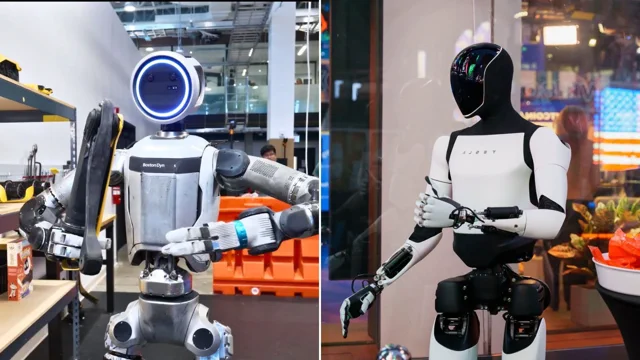
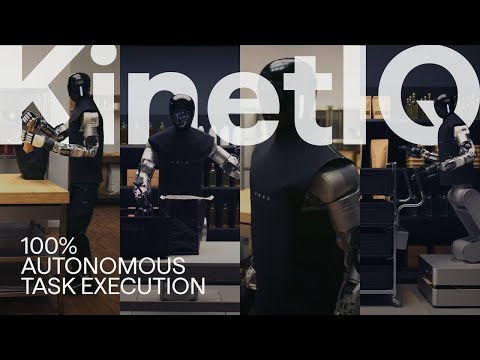
In the high-stakes race to build the definitive artificial brain for humanoid robots, a fascinating philosophical schism is emerging. It’s not just about who can make a robot walk or fetch a soda anymore. The real war is being waged in the architecture of the mind itself. On one side, you have the prodigy—the end-to-end savant that learns by watching. On the other, you have the meticulously organized bureaucracy. Stepping confidently into the latter camp is Humanoid with its new AI framework, KinetIQ, a system designed not just to control one robot, but to conduct an entire orchestra of them.
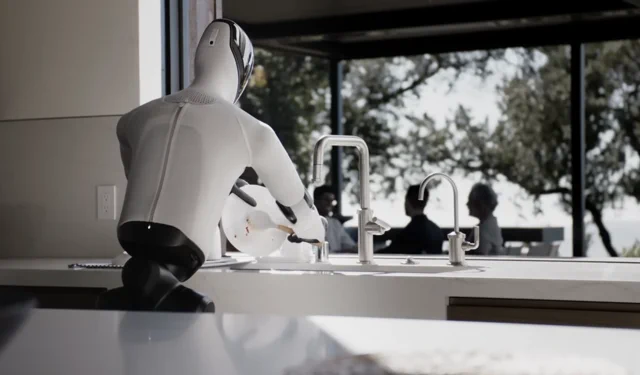
This immediately sets up a compelling showdown with Figure AI, whose Figure's Helix 02 Ditches Code for a Brain That Can Do the Dishes has stunned audiences with its fluid, long-form autonomy. Where Figure focuses on creating a single, unified neural network that learns complex, multi-step tasks, Humanoid is tackling the arguably messier, more industrial problem of fleet management. It’s a battle between the virtuoso and the general contractor, and the outcome could define how robots integrate into our world for decades to come.
KinetIQ: A Corporate Ladder for Cognition
Humanoid’s KinetIQ is built on what it calls a “cross-timescale” architecture, which is a fancy way of saying it’s a four-layer cake of command and control. It’s an agentic framework that thinks like a corporation, with each layer operating at its own speed and level of abstraction.
At the very top sits System 3, the Agentic Fleet Orchestrator. This is the C-suite, integrating with factory or warehouse management software to receive high-level goals. It operates on a timescale of seconds to minutes, treating each robot in its diverse fleet—be it bipedal or wheeled—as a resource to be deployed for maximum efficiency.
One rung down is System 2, the robot-level project manager. This layer uses an omni-modal language model to interpret System 3’s directives and break them down into a sequence of sub-tasks for a single robot. It reasons about the environment and can dynamically alter its plan, essentially problem-solving on the fly.
Giving the moment-to-moment instructions is System 1, a Vision-Language-Action (VLA) network that acts as the team lead. Operating at a brisk 5-10Hz, it issues a continuous stream of target poses for the robot’s body parts—hands, torso, pelvis—to execute the plan laid out by System 2.
And finally, doing the actual heavy lifting, is System 0. This is the whole-body controller, running at 50Hz and trained exclusively on around 15,000 hours of reinforcement learning in simulation. Its sole, frantic purpose is to translate the pose targets from above into stable, balanced joint movements, ensuring the robot doesn’t face-plant while trying to pick up a box.
Helix 02: The End-to-End Virtuoso
In the other corner stands Figure AI’s Helix 02, a system with a fundamentally different philosophy. Instead of a multi-layered bureaucracy, Helix 02 is built around a single, unified visuomotor neural network. Its mantra is “all sensors in, all actuators out,” connecting vision, touch, and proprioception directly to every joint in one continuous system.
While also hierarchical, its structure is more compressed:
- System 2 handles the high-level semantic reasoning, much like KinetIQ’s upper echelons.
- System 1 is where the magic happens. It’s a powerful policy that translates perception directly into full-body joint targets at a speedy 200Hz.
- System 0 is its foundation for physical embodiment, a controller that ensures movements are smooth and stable. But unlike KinetIQ’s pure RL approach, Helix’s System 0 was trained on over 1,000 hours of human motion data, learning the nuances of human-like balance and coordination before being refined with RL. It also operates at a blistering 1 kHz.
This approach is what enabled Figure to demonstrate its robot autonomously completing a four-minute dishwasher loading and unloading task—a feat of long-horizon autonomy that remains a benchmark in the field.
A Tale of Two Brains: A Philosophical Divide
The differences between KinetIQ and Helix 02 are not just technical—they represent two distinct visions for the future of robotics.
| Feature | Humanoid KinetIQ | Figure AI Helix 02 |
|---|---|---|
| Primary Goal | Fleet orchestration of diverse robots | Long-horizon autonomy in a single robot |
| Architecture | 4-layer agentic framework | 3-layer unified visuomotor network |
| System 0 Training | ~15,000 hours of pure Reinforcement Learning | 1,000+ hours of human motion data + RL |
| System 0 Speed | 50 Hz | 1000 Hz (1 kHz) |
| Key Strength | Scalability, reliability, and management of varied platforms. | Fluidity, dexterity, and learning complex, novel tasks. |
| Analogy | A well-run logistics company. | A highly-trained solo athlete. |
KinetIQ’s agentic, layered design is pragmatic. By separating concerns, Humanoid can theoretically improve, debug, or even replace individual layers without rebuilding the entire system. This modularity is ideal for industrial settings where reliability and coordination across many machines are paramount.
Figure’s end-to-end approach is more ambitious in its pursuit of general intelligence. By training the system on human data, it aims to create a foundational model for physical action that is inherently more graceful and adaptable to the unstructured chaos of the real world. It learns how to move like a person, not just how to achieve a goal.
The Real Race: From Dazzling Demos to Dirty Jobs
Ultimately, the superior architecture will be determined not in the lab, but on the factory floor and in our homes. Humanoid is betting that the immediate, multi-billion-dollar prize is in logistics and manufacturing, where orchestrating fleets of specialized robots is the core challenge. KinetIQ is purpose-built for that world.
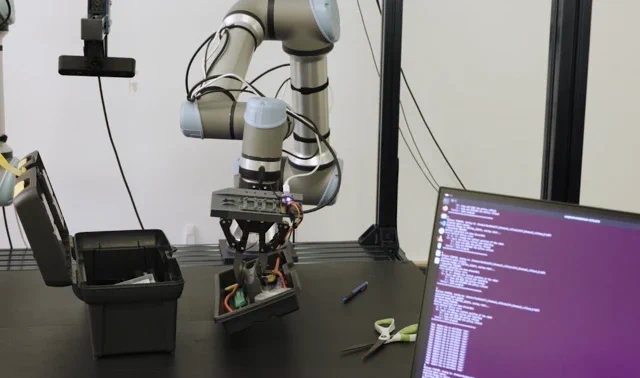
Figure AI, with its focus on complex, human-centric tasks, seems to be playing a longer game, aiming for a true general-purpose robot that can one day navigate any human environment. The stunning dexterity demonstrated—from handling pills to dispensing precise syringe volumes—showcases a system pushing the boundaries of fine motor control.
The race is on. Will the future of robotics be run by a meticulous AI fleet manager or a virtuosic robotic prodigy? KinetIQ is a powerful argument for the former, a system designed not for the highlight reel, but for the grueling reality of 24/7 industrial deployment. For more information, you can read the original announcement at thehumanoid.ai.